
Breadcrumbs
These links will help you get back to where you want to go faster.
Home Security in Maricopa: Why Mechanical Locks Outshine Smart Lock Hype
Traditional Locks Are More Secure Than Smart Home Locks
In today’s technology-driven world, the allure of smart locks and connected home security gadgets is undeniable. Many homeowners in Maricopa, Arizona, are tempted by the convenience of digital locks and internet-enabled devices, assuming they offer superior protection. However, a deep dive into security research and real-world experience reveals a different story: traditional mechanical locks, combined with proven physical security measures, remain the cornerstone of effective home defense.
Looking for a local and reliable locksmith? Save 50-80% on Locksmith Services such as Auto Lockout, Auto Remote Key Duplication, Mailbox Locksmith, Rekey, Home Lockout, and Commercial Locksmith. Call 602-369-1553 or 520-303-1022, or schedule an appointment online.
What you will learn in this article
– Traditional mechanical locks remain more secure than smart locks for home security in Maricopa, Arizona.
– Smart locks offer convenience like keyless entry and remote access but have vulnerabilities such as software bugs, hacking risks, battery failures, and climate-related reliability issues.
– Security flaws in some smart lock systems have exposed thousands of homes, and privacy concerns are leading to legal scrutiny and regulations requiring physical key alternatives.
– Research shows mechanical security measures (e.g., strong deadbolts, reinforced doors, and visible locks) significantly reduce burglary risk, often outperforming alarms and smart devices alone.
– Burglars tend to avoid homes with visible, robust mechanical barriers as they seek easy, quick intrusions.

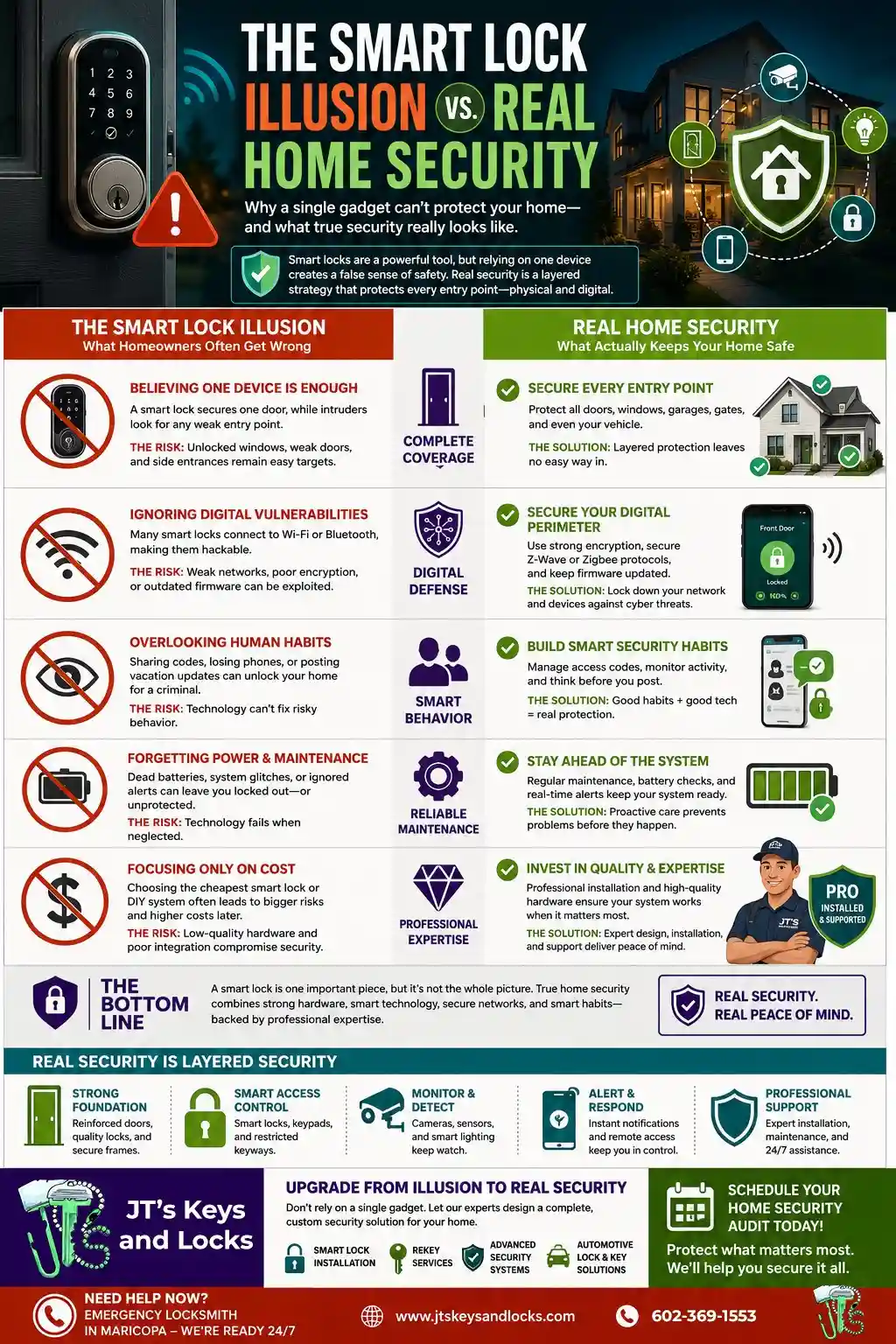
– Smart locks should enhance but not replace mechanical security; they work best when combined with fortified doors, deadbolts, and environmental deterrents like lighting and landscaping.
– The best home security strategy involves layering mechanical strength, environmental design, modern technology, and personal vigilance to protect homes and families effectively.
Understanding the Landscape of Home Security Technology
Smart Locks: Convenience with Hidden Vulnerabilities
Smart locks promise keyless entry, remote access, and integration with broader smart home systems, but these benefits come with critical trade-offs. Recent studies show that digital security devices introduce new risks including software bugs, battery failures, and hacking threats. In fact, attacks on smart home devices increased by 124% in 2024 alone, far outpacing manufacturers’ abilities to patch vulnerabilities.
For example, a severe security flaw in the Chirp Systems app—a popular smart lock controller—allowed unauthorized users to bypass lock controls remotely, exposing tens of thousands of homes to risk. Other models have been discovered with hard-coded credentials, leaving physical security compromised by weak digital safeguards.
Environmental and Hardware Limitations
Maricopa’s harsh desert climate also presents challenges for smart lock reliability. High temperatures often cause battery failures or motor strain in smart locks, leading many property managers to revert to traditional mechanical locks for consistent performance. Unlike electronic locks, mechanical locks do not rely on power sources or connectivity to function.
Privacy Concerns and Legal Trends
Privacy implications of smart locks are increasingly coming under legal scrutiny. For instance, Oregon’s HB 3378 mandates landlords to provide physical key alternatives if smart locks are installed, due to surveillance concerns. Similar legislation is pending elsewhere, highlighting growing unease about digital monitoring embedded in these devices. This movement signals that physical keys and manual controls remain essential safeguards against privacy invasion.
What the Research Reveals About Effective Home Security
Proven Security Combinations Beat High-Tech Gimmicks
| Finding | Source | Impact |
|---|---|---|
| Homes using the WIDE security system (Window locks, Indoor timed lights, Door deadlocks, External sensor lights) are 49 times less likely to be burgled. | Nottingham Trent University (20 years of crime data) | Mechanical-based measures provide superior protection |
| Door quality and strong deadbolts are the primary deterrents against forced entry. | New York State household survey (1983-1984) | Solid construction and locks stop most break-in attempts |
| Burglar alarms alone do not effectively prevent break-ins and can sometimes reduce overall security effectiveness. | Nottingham Trent University research | Physical barriers trump passive alarms |
| Visible, robust locks deter 60% of convicted burglars from attempting entry. | Multiple law enforcement studies | Deterrence depends on visibility and resistance |
| Half of burglaries involve unlocked doors rather than compromised locks. | Aurora Police Department / Bureau of Justice Statistics | Human behavior is a critical security factor |
| Delaying a burglar for four minutes generally thwarts an attempted break-in. | Crime prevention consensus | Time and friction are key defensive elements |
The Physics of Forced Entry: Why Mechanical Strength Matters
Physical strength is the fundamental security truth often obscured by high-tech marketing. ANSI Grade 1 deadbolts, the highest residential security standard, can endure over 800 pounds of force and multiple battering ram strikes without failing.
In contrast, many smart locks and inexpensive doorknobs offer minimal resistance. According to FBI data, 34% of burglaries involve kicking in a compromised front door, so reinforcing the door frame and strike plate is crucial.

Additionally, many residential doors are installed with inadequate 1-inch screws securing the strike plate to thin trim, allowing a single kick to break the lock’s hold regardless of its price or features. Upgrading to 3-inch hardened steel screws embedded into wall studs dramatically increases resistance and security.
Insights from Burglars: What Intruders Fear Most
Studies surveying convicted burglars reveal that visible physical barriers heavily influence target selection. About 60% of offenders abandon break-in attempts when confronted with robust mechanical locks that require noisy or time-consuming methods to bypass. Essentially, burglars look for quick, silent victims, and effective mechanical deterrents buy valuable time or cause potential intruders to reconsider.
The Smart vs. Mechanical Locks Debate: Finding the Balance
Why Smart Locks Should Be an Enhancement, Not a Replacement
Smart locks bring convenience and monitoring capabilities but fall short as standalone protection. Features like remote access, audit trails, and integration with cameras and alarms are valuable for property managers and frequent travelers. However, these devices must be built upon a solid foundation of mechanical security to be effective.
For example, a smart lock without a reinforced door frame or high-quality deadbolt remains vulnerable to physical attacks. Mechanical security buys the time and creates the barriers that digital alerts cannot enforce.
Looking for a local and reliable locksmith? Save 50-80% on Locksmith Services such as Auto Lockout, Auto Remote Key Duplication, Mailbox Locksmith, Rekey, Home Lockout, and Commercial Locksmith. Call 602-369-1553 or 520-303-1022, or schedule an appointment online.
Recommended Hybrid Security Approach
An optimal home security system layers mechanical fundamentals with thoughtful smart technology and environmental deterrents. This hybrid model includes:
- Mechanical security fundamentals: Solid-core or metal doors, ANSI Grade 1 deadbolts, reinforced strike plates with long screws, tightly fitting doors, and window locks.
- Environmental hardening: Motion-sensor or timer-controlled outdoor lighting, alarm system signage, maintained landscaping that limits hiding spots, and visible cameras.
- Smart technology enhancements: Smart locks with local processing capabilities (to avoid cloud failures), remote monitoring tools, integration with other smart devices, and keeping physical keys as backups.
- Behavioral practices: Consistently locking doors and windows and responding promptly to alerts.
Practical Recommendations for Maricopa Homeowners
When Considering Smart Locks
Do not sacrifice mechanical security for digital convenience. Instead, maintain or upgrade traditional locks and door hardware first. Then, augment your system with smart locks that complement your mechanical defenses, providing added control and awareness without compromising the physical barrier.
Upgrading Existing Mechanical Locks
Prioritize installing high-grade deadbolts and reinforcing door frames with hardened strike plates and long screws. These changes alone can prevent most forced entries and are significantly more impactful than smart lock features. Adding outdoor lighting and alarm signage further deters opportunistic burglars.
Evaluating Older Locks
Have your existing locks inspected by a professional locksmith to assess their condition and effectiveness. Mechanical components degrade over time, and a 30-year-old deadbolt may no longer provide adequate protection. Modern Grade 1 deadbolts offer vastly improved resistance to drilling, bumping, and physical force.
Why JT’s Keys and Locks Is Maricopa’s Trusted Security Partner
With deep expertise in mechanical security and an understanding of local security challenges, JT’s Keys and Locks focuses on durable, science-backed solutions. We specialize in reinforcing your home’s physical barriers—upgrading strike plates, installing Grade 1 deadbolts, and providing bump-proof cylinders with restricted keyways to control access securely.

Our mobile locksmith services extend beyond residential needs, offering commercial master key systems, advanced automotive locksmith assistance, and comprehensive security audits tailored to Maricopa’s desert environment.
Choosing JT’s Keys and Locks means investing in proven mechanical security rather than fleeting digital trends. Schedule a free home security assessment today—ensure your home is protected by barriers that truly deter burglars and give you peace of mind.
The Foundation of Real Home Security
The evidence is clear: mechanical locks and physical security fundamentals remain the most effective defense against burglary, especially in Maricopa’s unique environment. Smart locks and digital gadgets offer convenience and monitoring but do not replace the essential role of solid doors, reinforced frames, and high-quality deadbolts.
Homeowners should adopt a layered approach, combining the “WIDE” method—window locks, indoor/outdoor lighting, door deadlocks, and external sensor lights—with selective smart technology for enhanced control.
Ultimately, security is a blend of engineering, environmental design, technology, and personal vigilance. Professional locksmiths like JT’s Keys and Locks provide the expertise to integrate these elements into a reliable system that protects your home, your family, and your peace of mind.
Looking for a local and reliable locksmith? Save 50-80% on Locksmith Services such as Auto Lockout, Auto Remote Key Duplication, Mailbox Locksmith, Rekey, Home Lockout, and Commercial Locksmith. Call 602-369-1553 or 520-303-1022, or schedule an appointment online.