
Breadcrumbs
These links will help you get back to where you want to go faster.
11 Critical Home Security Mistakes Arizona Homeowners Must Avoid—And How Modern Technology Can Help
Protecting your home in Maricopa, Arizona, demands more than just locking the front door—it requires a strategic approach blending physical security, behavioral awareness, and cutting-edge technology. Residential burglaries remain a prevalent concern nationwide, with the FBI indicating that nearly 70% of property crimes involve unauthorized home entries. Unsurprisingly, homes lacking robust security measures are almost three times more likely to be targeted. At JT’s Keys and Locks, we understand how criminals exploit common security oversights and outdated technology, and we are committed to helping homeowners fortify their defenses using evidence-backed strategies and modern innovations.
Looking for a local and reliable locksmith? Save 50-80% on Locksmith Services such as Auto Lockout, Auto Remote Key Duplication, Mailbox Locksmith, Rekey, Home Lockout, and Commercial Locksmith. Call 602-369-1553 or 520-303-1022, or schedule an appointment online.
What you will learn in this article
– Protecting homes in Maricopa, Arizona requires a strategic combination of physical security, behavioral awareness, and modern technology due to the high risk of residential burglaries.
– Traditional security methods like simple deadbolts and hidden spare keys seem to be outdated and maybe insufficient against today’s burglars who may try to use physical and cyber techniques.
– Door frames and strike plate hardware are common weak points; upgrading to heavy-duty strike plates with long screws anchored into wall studs greatly enhances security.
– Inexpensive locks with low ANSI ratings are vulnerable to lock bumping and picking; high-security locks with anti-drill and anti-pick features provide stronger protection.
– Common physical key hiding spots (under doormats, rocks, or above doors) are risky; smart locks with rolling-code encryption or biometric readers eliminate the need for physical keys.

– Low-quality smart locks and unsecured wireless protocols pose cybersecurity risks; choosing reputable brands with strong encryption and secure networking is crucial.
– Smart lighting and motion sensors, especially those with advanced object recognition, improve perimeter security and reduce burglary risk.
– Managing digital privacy and using smart home automation to simulate occupancy helps deter burglars by concealing when homes are unoccupied.
– Secondary entry points like sliding glass doors require additional locks and shatter-resistant films to prevent easy break-ins.
– Garages connected to homes must have secure interior doors and rolling-code garage door openers to block signal interception.
– Modern key fobs with motion-sensing sleep modes protect vehicles from relay attacks that can enable theft.
Understanding the Evolving Landscape of Home Security
Gone are the days when a simple deadbolt and a spare key hidden under the doormat offered dependable security. Today’s intruders leverage not only traditional physical methods like force and lock manipulation but also take advantage of behavioral patterns and cybersecurity vulnerabilities. Effective home security combines mechanical strength with smart technology and informed habits, providing a multi-layered defense to deter and delay potential burglars.
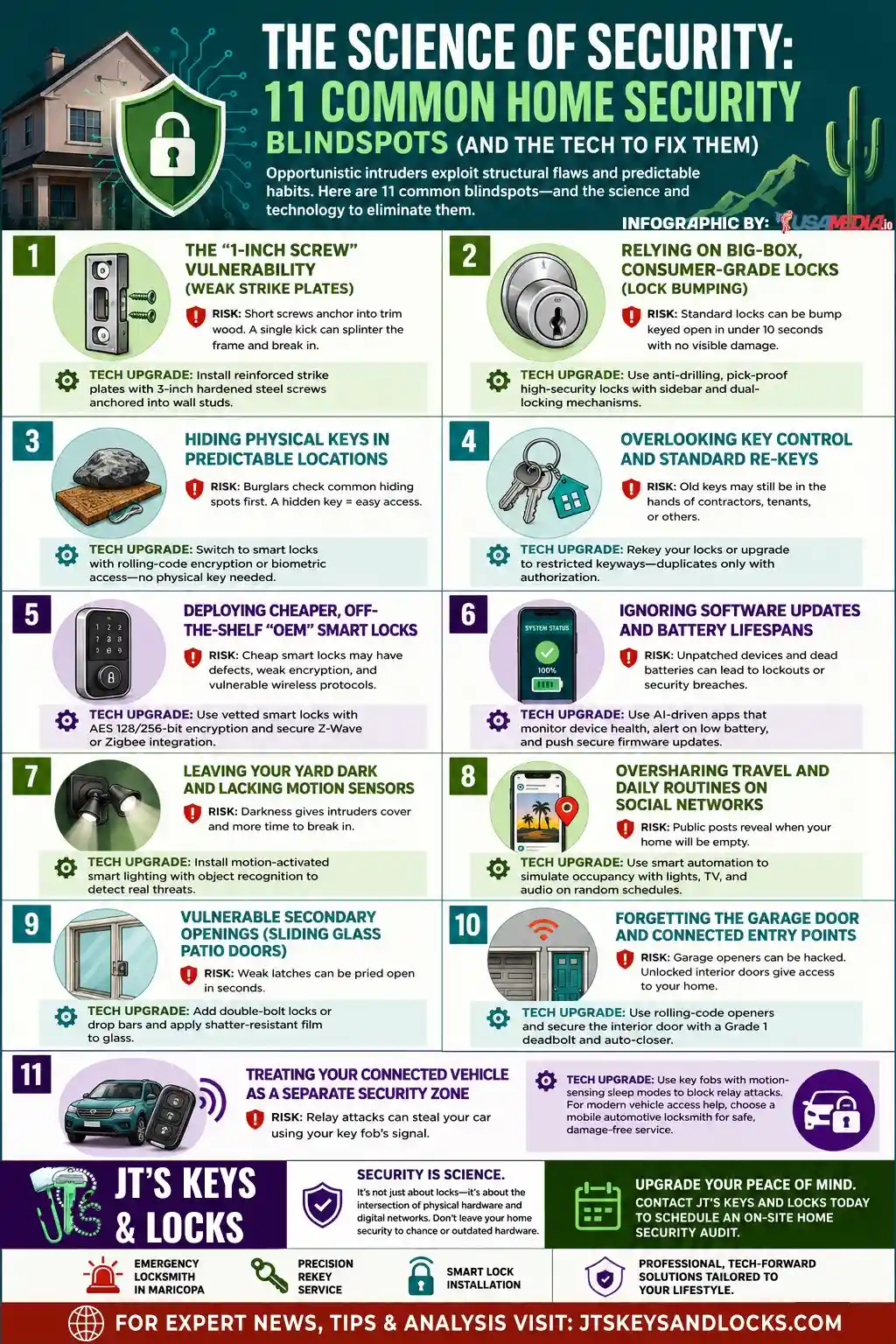
1. The Hidden Weakness of Door Hardware: Why Reinforcement Matters
Many homeowners mistakenly believe that a solid door and standard lock are enough to keep intruders out, but the real vulnerability often lies in the door frame and strike plate hardware. Typical installations anchor strike plates with short 1-inch screws, which only latch onto decorative trim wood, making the door susceptible to forced entry through kicking or prying.

Scientific analysis shows that the mechanical integrity of your door is directly tied to the depth and strength of its fasteners. Upgrading to heavy-duty strike plates secured with 3-inch hardened steel screws, anchored deep into the wall studs, significantly improves resistance against forceful impacts and reduces the likelihood of a break-in.
2. Avoiding the Pitfalls of Inexpensive Locks and Lock Bumping
Standard locks widely available at big-box stores often carry only an ANSI Grade 3 rating, making them vulnerable to lock bumping and picking. Lock bumping exploits the kinetic transfer of force to momentarily disengage the lock’s pins, allowing entry within seconds without leaving physical damage.
High-security locks equipped with anti-drill, anti-pick, and dual-locking mechanisms represent the most reliable defense against these techniques. Their specialized sidebars and hardened materials prevent the transfer of the bumping force, while also resisting drilling attacks, maintaining physical security integrity.
3. The Danger of Predictable Physical Key Hiding Spots
Disguising spare keys under doormats, fake rocks, or above door frames is one of the most common and dangerous security blind spots. Experienced burglars routinely check these locations first, gaining easy, undetected entry if a key is found.
Modern smart lock systems using rolling-code encryption or biometric readers eliminate the need for physical keys, effectively closing this vulnerability. These electronic deadbolts can be managed remotely, provide detailed access logs, and allow controlled permissions without the risk of unauthorized duplication.
4. Managing Key Control: Rekeying and Restricted Keyways
A frequent oversight occurs when homeowners neglect to rekey locks upon moving into a new residence. Previous occupants, contractors, or realtors may still possess copies of physical keys, undermining the security of the entire property.
A professional locksmith’s rekey service rearranges the internal pin tumblers, rendering old keys useless while maintaining existing hardware. For heightened security, restricted keyways that require authorized identification to duplicate keys ensure that unauthorized copies cannot be readily made, safeguarding physical access.
5. Steering Clear of Low-Quality Smart Locks and Vulnerable Wireless Protocols
The surge of inexpensive IoT devices has flooded the market with smart locks that often lack adequate security features, rendering them prone to hacking, firmware flaws, and wireless attacks. Many budget models operate on unsecured or unencrypted networks, exposing homeowners to digital interception and signal jamming.

Choosing reputable smart lock brands that employ advanced encryption standards like AES 128- or 256-bit, and pairing these with secure home networking protocols such as Z-Wave or Zigbee, dramatically enhances cybersecurity. Professional installation ensures devices are properly integrated and protected against vulnerabilities.
6. The Importance of Regular Software Updates and Battery Maintenance
Connected security devices degrade in effectiveness if firmware updates are ignored or batteries left unmonitored, leading to lockouts or security gaps. Cybercriminals actively scan for outdated firmware vulnerabilities to infiltrate smart home systems.
Modern smart home ecosystems leverage AI-driven automation to monitor device health, send push notifications when batteries run low, and push encrypted over-the-air updates. This proactive approach maintains optimal performance and resilience against evolving cyber threats.
7. Enhancing Perimeter Security with Smart Lighting and Motion Sensors
Dark exteriors provide intruders with concealment, allowing them to tamper with locks away from prying eyes. Studies demonstrate that well-lit properties reduce burglary risk by up to 56% by increasing perceived apprehension risk.
Looking for a local and reliable locksmith? Save 50-80% on Locksmith Services such as Auto Lockout, Auto Remote Key Duplication, Mailbox Locksmith, Rekey, Home Lockout, and Commercial Locksmith. Call 602-369-1553 or 520-303-1022, or schedule an appointment online.
Integrating motion-activated smart lighting with advanced object recognition—capable of distinguishing humans from animals or environmental noise—provides targeted illumination only when needed. This approach reduces energy costs while improving deterrence and video capture quality during attempted intrusions.
8. Maintaining Digital Privacy and Simulating Occupancy
Oversharing daily routines or travel plans on social media inadvertently advertises when homes are unoccupied, inviting break-ins. Criminals monitor public profiles and geotags to identify vulnerable targets.
In addition to managing privacy settings, employing smart home automation that randomly toggles lights, televisions, and audio systems simulates occupancy, confusing and deterring potential burglars. These systems help maintain a lived-in appearance, even when homeowners are away for extended periods.
9. Fortifying Vulnerable Secondary Entry Points Like Sliding Glass Doors
Sliding glass patio doors, often overlooked, are common entry points due to their weak factory latches and easy prying opportunities. Burglars exploit these less visible access points frequently, particularly those shielded from street view.
Improvements include installing robust secondary locks such as double-bolt systems or foot-operated drop bars, paired with shatter-resistant window film to prevent smash-and-grab scenarios. This combination significantly raises the barrier to entry.
10. Securing the Garage and Connected Interior Access
Attached garages present a unique risk when the interior door connecting to the house is left unlocked or garage door openers use outdated fixed-code systems. Intruders may intercept radio signals to open garage doors, subsequently gaining concealed access to the home.
Modern rolling-code garage door openers utilize encrypted digital certificates that change with every use, preventing signal replay attacks. reinforcing the interior door with a Grade 1 deadbolt and adding automatic door closers further minimizes risk, safeguarding the living space even if the garage is breached.
11. Protecting Connected Vehicles from Relay Attacks
With the rise of keyless entry and electric vehicles, attackers increasingly use relay attacks to capture and transmit key fob signals, unlocking and stealing cars parked near the home. Signals emitted from fobs left near doors or countertops can be amplified and relayed to the vehicle.
Advanced key fob programming now incorporates motion-sensing sleep modes that deactivate transmissions when the fob is stationary, blocking relay attacks. Consulting with automotive locksmiths experienced in modern vehicle access systems ensures secure, damage-free lockouts and electronic key cloning if necessary.
Building a Comprehensive, Science-Backed Security Strategy
Home security in Maricopa demands a multi-layered approach that combines durable mechanical hardware with intelligent security technologies and informed behavioral practices. By addressing the 11 common vulnerabilities—from weak strike plates and outdated locks to careless digital habits and connected device maintenance—homeowners can significantly reduce their risk of burglary and unauthorized access.
JT’s Keys and Locks offers expert assessments, installation, and upgrades tailored to Arizona’s unique environment and residential needs. Through a blend of structural reinforcement, high-grade locks, smart technology integration, and ongoing maintenance, we empower you to protect your family and property effectively.
Don’t wait for a break-in to take action—contact JT’s Keys and Locks today for a thorough home security audit and proactive solutions. Experience peace of mind knowing your home is safeguarded by the latest advancements paired with trusted locksmith expertise.
Looking for a local and reliable locksmith? Save 50-80% on Locksmith Services such as Auto Lockout, Auto Remote Key Duplication, Mailbox Locksmith, Rekey, Home Lockout, and Commercial Locksmith. Call 602-369-1553 or 520-303-1022, or schedule an appointment online.